Selective routing
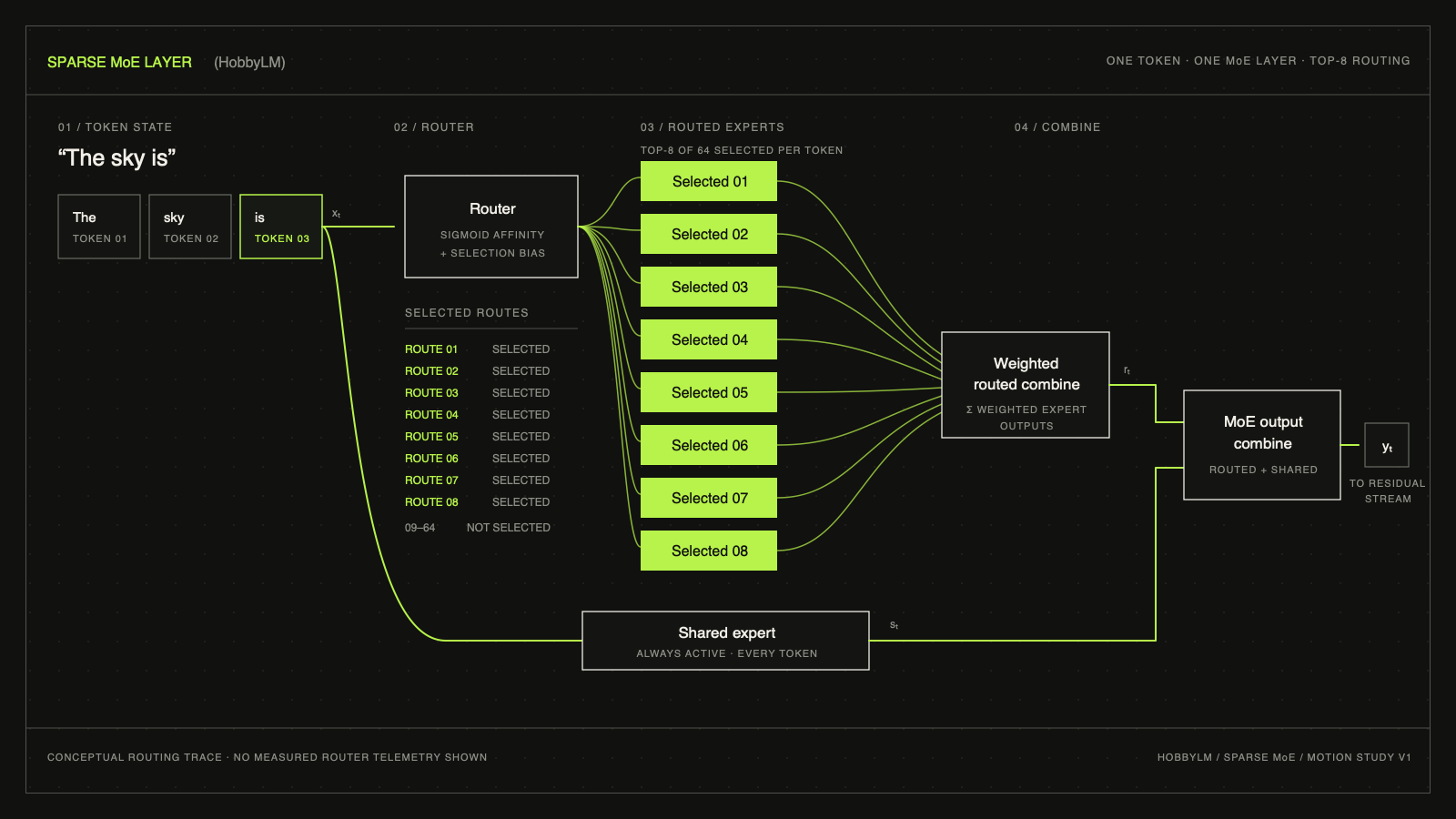
For each token, HobbyLM activates a selected subset of computational paths and combines their outputs before continuing through the model.
Fuel Labs documents how HobbyLM is built, trained, and evaluated. Articles publish when their evidence and review are complete.
A model record and its research record, presented together.
The current Fuel Labs language-model project.
Technical accounts publish as evidence and review are completed.
For each token, HobbyLM activates a selected subset of computational paths and combines their outputs before continuing through the model.
HobbyLM combines one dense decoder layer with 19 sparse mixture-of-experts layers. Each sparse layer selects eight of 64 routed experts per token and evaluates one shared expert on every token.
HobbyLM runs locally on Apple silicon through MLX, with sparse selected-expert computation and KV-cached decoding.
fuel ~ % git clone https://github.com/fuellabs/hobbyLM.git
Cloning into 'hobbyLM'...
fuel ~ % cd hobbyLM && hobbylm-mlx \
    --prompt "Explain sparse routing in one sentence."
HobbyLM
Sparse routing activates only the experts most relevant to each token, reducing computation while preserving model capacity.